I'm Not Lost I'm Exploring SVG PNG: Choosing the Right Format for Your Project
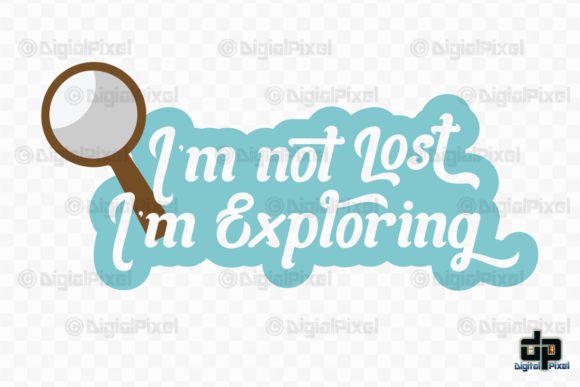
The phrase "I'm Not Lost I'm Exploring" has become a popular mantra for travelers, hikers, and anyone who embraces a curious, wandering mindset. When you search for this design, you will likely encounter two primary file formats: SVG and PNG. Both serve the same graphic but behave very differently depending on how and where you plan to use it. Understanding the distinction between an I'm Not Lost I'm Exploring SVG PNG file can save you time, frustration, and even money. This article breaks down what each format offers, where each excels, and how to decide which one fits your specific needs.
Whether you are designing a t-shirt, building a website, creating a poster, or preparing a digital scrapbook, the format you choose directly affects quality, flexibility, and ease of use. Let's walk through the key differences so you can make an informed choice without guesswork.
What Is an I'm Not Lost I'm Exploring SVG PNG Graphic?
At its core, the graphic is a visual representation of the phrase, often accompanied by compass motifs, map elements, arrows, or nature-inspired illustrations. The design can range from minimal typography to intricate artwork. However, the file format determines how that design behaves once you try to scale it, edit it, or place it on different backgrounds.
An I'm Not Lost I'm Exploring SVG file is a vector-based image. Vector graphics use mathematical paths rather than a fixed grid of pixels. This means the design can be scaled up to billboard size or down to a business card without losing any sharpness. SVG files are also text-based, which allows developers and designers to manipulate individual elements, change colors, or adjust text directly in code or in vector editing software.
An I'm Not Lost I'm Exploring PNG file, by contrast, is a raster image. It is composed of a fixed number of pixels. When you zoom in, you will eventually see individual pixels, and enlarging the image beyond its original dimensions causes blurriness or blockiness. PNG files do support transparency, meaning the background can be invisible, which makes them convenient for placing over other images or colored backgrounds without a white box around the design.
Both formats can carry the same visual design, but they are fundamentally different tools suited to different jobs.
Comparing SVG and PNG: Where Each Format Shines
When evaluating an I'm Not Lost I'm Exploring SVG PNG option, it helps to think of your final output. There is no universal "better" format, only a format that is better for your particular use case.
Scalability and Resolution
The most noticeable difference between SVG and PNG is how they handle size. SVG files remain crisp at any scale because they are resolution-independent. If you plan to print the design on a small sticker and also on a large canvas banner, an SVG file will adapt perfectly to both sizes without requiring a separate high-resolution version. PNG files, on the other hand, are resolution-dependent. A PNG that looks sharp on a 300×300 pixel web badge may become noticeably pixelated when stretched to fit a 24-inch poster. For print projects that require large dimensions, an SVG file is almost always the safer choice unless you have access to a very high-resolution PNG created at the exact size you need.
Editing and Customization
If you want to change the color of the text, swap out a compass icon, or adjust the spacing between letters, an SVG file gives you that freedom. Because it is a vector file, you can open it in software like Adobe Illustrator, Inkscape, or Affinity Designer and edit individual components as separate objects. A PNG file is essentially a locked image. You can resize or crop it, but changing the color of the text or modifying an element is much harder and often requires advanced image editing skills. If you anticipate making adjustments later, or if you are working with a designer who needs flexibility, the SVG format is far more practical.
File Size and Web Performance
SVG files are typically smaller than PNG files for simple designs, especially those with solid colors and clean lines. A straightforward I'm Not Lost I'm Exploring typographic design saved as an SVG might be only a few kilobytes. The same design as a high-resolution PNG could be ten to twenty times larger. For website owners, this matters. Smaller file sizes mean faster loading times, which improves user experience and can positively affect search engine rankings. If you are adding the graphic to a website, blog, or online store, an SVG file is generally the lighter, faster option. However, if the design contains complex gradients, photographic textures, or many tiny details, a PNG might actually load more efficiently because SVG files with extreme complexity can become large and slow to render in a browser.
Transparency and Background Handling
Both SVG and PNG support transparent backgrounds, but they handle transparency differently. A PNG with transparency is a flattened image, so the transparent area is fixed. You can place it over a colored background in most design software or on a website, and the background will show through. An SVG file also supports transparency, but because it is code-based, you can adjust the opacity of individual elements, apply gradients, or even animate parts of the design. For most everyday uses, both formats handle transparency well. The real difference emerges when you need to layer the graphic over a complex background or print it on a colored surface. In those cases, SVG offers more flexibility because you can fine-tune how each element interacts with what is behind it.
Strengths and Tradeoffs of Each Format
Every format comes with compromises. Recognizing the tradeoffs helps you avoid a mismatch between your file and your project.
When SVG Is the Stronger Choice
- Print projects that require multiple sizes: If you plan to use the same design on a business card, a poster, and a banner, one SVG file covers all sizes.
- Apparel decoration: Screen printing and heat transfer often work best with vector files, especially when separating colors for production.
- Web and mobile interfaces: SVG files are lightweight, scalable for responsive design, and can be styled with CSS or manipulated with JavaScript.
- Collaboration with professional designers: A vector file gives designers the freedom to tweak, remix, and optimize the artwork for different media without starting from scratch.
When PNG Is the Stronger Choice
- Quick uploads to social media or marketplaces: Many platforms accept PNG directly without requiring special software. You can download, upload, and use the graphic immediately.
- Photographic or highly detailed designs: If the I'm Not Lost I'm Exploring design includes rich textures, shading, or photo elements, PNG preserves that complexity better than SVG.
- When you lack vector editing software: Not everyone has access to Illustrator or Inkscape. PNG files can be opened in virtually any image viewer or basic editor, including free tools and mobile apps.
- Printing at a known, fixed size: If you only need one specific size and you have a high-resolution PNG at that exact dimension, the raster format works perfectly well and may require less technical knowledge to handle.
Decision Factors: Which Format Should You Choose?
Rather than asking which format is objectively better, ask yourself a few practical questions. Your answers will point you toward the right file.
What is the final output? If you are printing the design on a t-shirt, a tote bag, or a large wall art piece, SVG is almost always the professional standard. Many print shops prefer or require vector files because they produce cleaner results. If you are sharing the design digitally, such as in a social media post, an email signature, or a digital planner, a PNG is often more convenient and works universally across platforms.
How much control do you need? If you want to customize the colors, rearrange elements, or combine the graphic with other artwork, start with an SVG. If you simply want the design as-is and do not plan to edit it, a PNG will save you the hassle of learning vector software.
What is your technical comfort level? SVG files sometimes require a bit of familiarity with design tools or code. PNG files are nearly foolproof. If you are not comfortable opening a vector application or troubleshooting a missing font, PNG is the lower-friction path.
Will you need the design at different sizes later? If there is any chance you will revisit this graphic for a larger or smaller project later, SVG eliminates the need to track down a higher-resolution version. One file serves all future needs.
Realistic Examples: Matching Format to Use Case
Consider a scenario where you are creating a blog about wandering and slow travel. You want the I'm Not Lost I'm Exploring graphic as a header image for your posts. If you use a PNG at 1200×600 pixels, it will look fine on desktop screens. But if someone views your blog on a high-resolution monitor or a 4K display, that PNG may appear slightly soft. An SVG, on the other hand, will render sharp on any screen size. This is a small detail that can make your site feel more polished to visually attentive readers.
Now imagine you are organizing a hiking retreat and want to print the design on stickers, banners, and participant badges. With an SVG, you can take the same file and scale it down for a 2-inch sticker and up for a 3-foot banner without any loss in quality. With a PNG, you would need separate files at different resolutions, and the largest version might still look imperfect if the original was not created at an extremely high resolution.
Another common example: you are selling merchandise on an online marketplace that lets you upload a design for print-on-demand apparel. Many of these platforms accept both PNG and SVG, but they often recommend vector formats for text-heavy designs because the text remains crisp even after resizing. If your I'm Not Lost I'm Exploring graphic relies on fine typography or small compass details, an SVG file will produce a more professional print.
When Neither Format Is Ideal
There are situations where even the best SVG or PNG file may not be sufficient. If you need a format that supports layers, advanced color profiles, or compatibility with specific printing standards, you might need an EPS, AI, or PDF file instead. Some professional print shops request vector files in EPS or AI format for large-format printing. Likewise, if you need a file that can be opened across many operating systems without any software, a PNG is more universal than SVG, but JPEG might be even more compatible if transparency is not required.
The key is to understand that an I'm Not Lost I'm Exploring SVG PNG file is a starting point. Your choice should align with the practical demands of your project, not with a general sense of which format is "better." SVG offers flexibility, scalability, and editability. PNG offers simplicity, broad compatibility, and immediate usability. Both are valid, and both have a place in a well-rounded toolkit.
Making Your Final Decision
If you are still unsure, consider keeping both formats on hand. Many designers and hobbyists download the design in SVG for future editing and printing, and also save a high-resolution PNG for quick digital use. Having both gives you the best of both worlds without forcing a single compromise.
When you evaluate an I'm Not Lost I'm Exploring SVG PNG resource, look at the file's resolution, license, and intended use. If the source offers both formats, you are in a good position to adapt to whatever comes next. If you are purchasing a design, ask yourself whether you might want to customize it later, print it at a large size, or use it across multiple platforms. If the answer to any of those questions is yes, lean toward the SVG version. If you need something that works immediately with minimal fuss, a well-crafted PNG will serve you well.
Ultimately, the right choice depends on your workflow, your tools, and your goals. There is no one-size-fits-all answer. By understanding the strengths and tradeoffs of each format, you can confidently select the file that supports your project from start to finish.