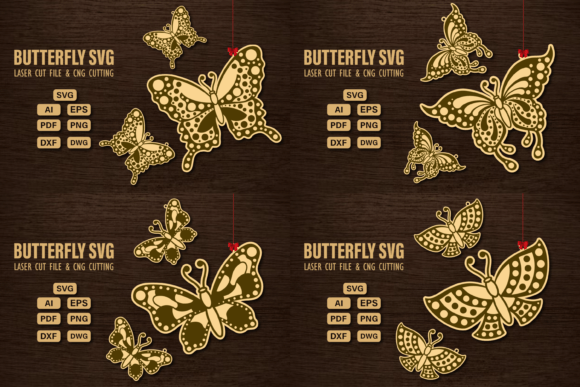
Butterfly Laser & CNC Cutting File SVG Guide
Butterfly designs are among the most popular subjects in the world of digital fabrication, and a well-made Butterfly Laser and CNC Cutting File SVG offers a direct path from screen to material. Whether you are just beginning to explore what a laser cutter or CNC router can do, or you have a workshop humming with projects, these vector files provide a ready-to-use template that takes the guesswork out of creating intricate butterfly shapes. The appeal is straightforward: you get a clean, scalable design that your machine can interpret and cut with precision, saving you hours of drawing and tweaking.
At its core, a Butterfly Laser and CNC Cutting File SVG is a vector graphic that defines the exact paths, curves, and cut lines needed to produce a butterfly shape. Because SVG (Scalable Vector Graphics) is an open-standard format, it works across most design and control software without compatibility headaches. The file tells your laser or router exactly where to cut, where to engrave, and where to leave material untouched. This means you can focus on choosing wood, acrylic, paper, or metal, and let the file handle the geometry.
Why Butterfly Designs Resonate with Makers
Butterflies hold a natural visual appeal. Their symmetry, elegant wing contours, and delicate internal patterns make them ideal for showing off what a laser or CNC machine can do. A Butterfly Laser and CNC Cutting File SVG captures that natural beauty in a format that machines understand. For a hobbyist, this might mean creating a set of decorative wall art pieces. For a small business owner, it could be the start of a product line—ornaments, earrings, cake toppers, or custom signage that customers gravitate toward.
The versatility of a butterfly cut file is also worth noting. The same SVG can be scaled to fit a small pendant or expanded into a large panel for a room divider. Because the design is vector-based, you can adjust individual elements, add text, or combine multiple butterflies into a composition without losing quality. This flexibility removes a common barrier: the fear of committing to a fixed size or layout before you see the final result.
Many creators also appreciate how butterfly designs work across different materials. A thin plywood butterfly cut with a laser has a charred edge that adds contrast. Cut the same file from acrylic, and you get a glossy, modern look. On a CNC router, you can carve the butterfly into a thicker piece of hardwood, adding depth and texture that feels substantial. The same SVG file adapts to each process because the toolpath generation software interprets the vectors for your specific machine.
Practical Benefits for Beginners and Professionals
If you are new to laser cutting or CNC routing, finding a reliable, well-tested Butterfly Laser and CNC Cutting File SVG can accelerate your learning curve. Instead of struggling with vector software and worrying about kerf, bridge cuts, or sharp corners, you can load the file and run a test cut on scrap material. This gives you immediate feedback on how your machine handles curves, thin lines, and detail. It also builds confidence—you see a real, physical object emerge from a digital file, and that is deeply motivating.
For experienced makers and professionals, these files save time and reduce repetitive work. When you have a backlog of orders or need to produce multiple pieces for a craft fair, a reliable SVG eliminates the need to redraw the same butterfly every time. You can open the file, adjust settings for your material, and start cutting. The consistency of a vector file also means that every piece matches the original design, which is essential for products sold in quantities.
Entrepreneurs and small business owners often turn to butterfly cut files because they have proven market demand. Wedding décor, nursery decorations, greeting cards, and home accessories featuring butterflies are consistently popular. By using a Butterfly Laser and CNC Cutting File SVG, you can quickly prototype new designs, test them with customers, and scale production without hiring a graphic designer for every variation. The file becomes a foundational asset that you can modify and combine with other elements to create a unique product catalog.
Where and How to Use Butterfly Cut Files
The range of applications for a Butterfly Laser and CNC Cutting File SVG is broader than many first assume. Here are some of the most common and creative ways people put these files to use:
- Home décor: Cut butterflies from plywood, MDF, or acrylic and mount them on walls, arrange them in shadow boxes, or suspend them as mobile pieces. Layering multiple sizes and colors adds depth.
- Jewelry and accessories: Scale the file down to produce earrings, brooches, or hair clips from thin wood or acrylic. The intricate wing patterns translate well into small, wearable art.
- Event and wedding supplies: Use butterfly cutouts as place card holders, table scatter, cake toppers, or invitation inserts. They add a whimsical touch that photographs beautifully.
- Signage and branding: Incorporate a butterfly shape into a business logo, store display, or custom sign. The clean lines of an SVG ensure professional results on routed wood or laser-cut acrylic.
- Educational projects: Teachers and educators use butterfly files in STEM and art classes to teach symmetry, design thinking, and digital fabrication. Students can design their own variations after studying the base file.
- Packaging and stationery: Cut butterflies from cardstock or kraft board for gift tags, bookmarks, or packaging embellishments. The file makes it easy to produce multiples in consistent quality.
Each of these use cases benefits from the same core property: the SVG contains precise, closed paths that the machine interprets without ambiguity. This reliability is what makes a Butterfly Laser and CNC Cutting File SVG a practical tool rather than just a pretty graphic.
Important Considerations Before You Choose a File
Not all butterfly SVG files are created equal, and knowing what to look for can save you time, material, and frustration. The quality of the vector paths matters significantly. A well-constructed file will have clean curves without unnecessary nodes, closed shapes for cut lines, and appropriate gap widths for the material thickness you plan to use. If a file appears to have jagged lines or overlapping paths when you zoom in, it may cause your laser or router to cut erratically.
You also need to consider the intended cutting method. A Butterfly Laser and CNC Cutting File SVG designed for a laser cutter typically includes thin cut lines and may incorporate scoring or engraving layers. For CNC routing, the file often needs toolpath adjustments, such as adding tabs to hold the piece in place or enlarging internal gaps to accommodate a router bit. Make sure the file you select matches your machine type and workflow, or be prepared to modify it in your design software.
Material choice interacts with the file design in practical ways. Intricate butterfly wings with very thin bridges may work well in stiff acrylic or thick plywood but could break in soft balsa or cardstock. If you are new to a material, always run a small test cut first. Likewise, check that the SVG dimensions match your material size before cutting. Many files come in multiple size variants or are designed to be scaled, but scaling too far can change the thickness of lines and affect structural integrity.
Licensing is another practical point. Some Butterfly Laser and CNC Cutting File SVG files are sold for personal use only, while others include commercial rights. If you plan to sell the finished products, verify the license terms. Reputable creators clearly state whether commercial use is allowed, and many offer tiered licenses for different scales of production. Respecting these terms supports the designers who put time into creating high-quality vectors.
Getting Started with Your First Project
If you have a butterfly SVG ready and a machine waiting, the best next step is a simple test project. Choose a material you are comfortable with, such as 3 mm plywood or 2 mm acrylic, and set your machine parameters according to the manufacturer's recommendations. Load the Butterfly Laser and CNC Cutting File SVG into your control software, check that the cut lines align with your material boundaries, and run a small sample. Look at the edges, the detail in the wings, and how the pieces fit together if the design includes interlocking parts.
From that first test, you will learn a lot. Maybe the internal cutouts need a slightly larger gap for your material, or perhaps the outer shape cuts faster if you adjust the power and speed. Keep notes on what works, and do not hesitate to modify the SVG in a vector editor to suit your preferences. Over time, you will develop a feel for how butterfly designs behave across different processes, and that knowledge will let you take on more complex projects with confidence.
A Butterfly Laser and CNC Cutting File SVG is more than just a digital file—it is a starting point for exploration. Whether you use it to create one perfect gift or a hundred products for a shop, the combination of natural beauty and digital precision makes it a valuable asset in any maker's toolkit.