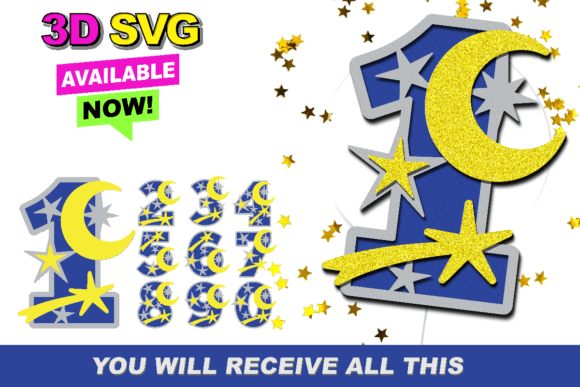
Moon Stars Numbers 3D SVG: Integrating Celestial Design with Numeric Clarity
Redefining Visual Communication through Lunar and Stellar Motifs
The digital landscape constantly seeks fresh ways to present information that is both accurate and visually compelling. Moon Stars Numbers 3D SVG represents a convergence of astronomical aesthetics and data representation, offering a format where numeric values are embedded within three-dimensional celestial imagery. This approach moves beyond simple flat icons, providing depth, texture, and a narrative quality that captures attention in educational materials, branding, interactive media, and scientific communication. By combining the universal appeal of moon phases and star fields with the precision of numerical data, designers and educators can create assets that are as functional as they are evocative.
Elevating User Interfaces and Digital Storytelling
In user interface design, numbers often serve functional roles—counters, timers, scores, or metrics. When rendered as Moon Stars Numbers 3D SVG, these elements become focal points that reinforce brand identity or thematic content. For example, a meditation app might use a glowing crescent moon as the background for a session timer, with stars marking intervals. The three-dimensional quality adds a sense of depth, making the interface feel more immersive without sacrificing readability. Similarly, children’s educational apps can turn counting exercises into a treasure hunt among constellations, where each number appears on a rotating moon surface. The SVG format ensures that these graphics remain crisp on any screen size, from smartwatches to 4K monitors.
Enhancing Printed Educational Materials
Educators benefit from the versatility of Moon Stars Numbers 3D SVG when designing worksheets, posters, and flashcards. A mathematics lesson on fractions might depict a moon split into segments, with each segment labeled numerically. Star clusters can represent sets for counting or pattern recognition exercises. The three-dimensional aspect helps students visualize abstract concepts—such as volume or layers—because the shading and perspective inherent in 3D SVG create a sense of physical space. These materials can be printed at high resolution or used digitally in interactive whiteboards, adapting seamlessly to classroom technology.
Branding and Event Theming
Businesses planning space-themed product launches, astrology-based services, or celestial wedding decor find that Moon Stars Numbers 3D SVG offers a cohesive visual language. Countdowns to an event can feature numbers formed by stars orbiting a crescent moon, while pricing tiers might be represented by moon phases. The 3D effect provides a premium, polished look that works well in both web banners and physical signage. Because SVG is vector-based, scaling these designs for billboards or business cards is straightforward without loss of quality. The ability to customize colors, gradients, and shading allows brands to align the graphics with their existing palette while retaining the celestial motif.
Scalability without Compromise
Unlike raster images, SVG (Scalable Vector Graphics) defines shapes using mathematical coordinates. When applied to three-dimensional representations of moon and star elements, this means that Moon Stars Numbers 3D SVG maintains its crispness, gradients, and lighting effects at any resolution. A number displayed as a 3D sphere with a moon texture will keep its smooth contours whether viewed on a mobile device or projected on a large screen. This scalability is critical for applications that must support responsive design or high-definition output. Furthermore, because the file is written in XML, it can be compressed efficiently, reducing load times for websites or digital publications.
Interactivity and Animation Potential
The SVG format supports interactivity through CSS and JavaScript, allowing Moon Stars Numbers 3D SVG to become dynamic elements. A star field surrounding a number can twinkle, or a moon can rotate slowly when hovered over. In educational contexts, students can click on parts of a 3D moon number to reveal its value or change its orientation. This transforms passive viewing into an engaging learning experience. Developers appreciate that such animations do not require external plugins, ensuring broad compatibility across browsers. The combination of 3D illusion and interactive capability makes these graphics suitable for gamified dashboards, data visualization tooltips, and interactive infographics.
File Size and Performance Considerations
While 3D effects within SVG are achieved through skillful use of gradients, filters, and paths rather than actual 3D engines, the resulting file sizes remain modest compared to equivalent raster images or heavier 3D formats like WebGL. Moon Stars Numbers 3D SVG can include complex shading with multiple stop points in gradients, but the total size typically stays under tens of kilobytes per element. This lightweight nature ensures fast rendering even on lower-powered devices. However, designers should be mindful of the number of gradient elements and filters used, as their rendering can occasionally slow down older browsers. Using well-optimized code and avoiding excessive shadow effects helps maintain performance without sacrificing the 3D illusion.
Tools and Techniques for Customization
Creating Moon Stars Numbers 3D SVG can begin in vector editing software such as Adobe Illustrator, Inkscape, or Affinity Designer. The process involves constructing a base shape—a circle for a moon, or a polygonal star—then applying radial gradients to simulate three-dimensional curvature. Adding a drop shadow or inner glow enhances the volumetric feel. For large-scale production, designers can set up libraries of reusable celestial components, such as craters, star shapes, and orbital paths, which can be combined with numeric text. Using symbolic references within SVG allows these components to be updated globally, which is beneficial for series of educational workbooks or themed event packages. For those less experienced with vector drawing, third-party marketplaces offer pre-made Moon Stars Numbers 3D SVG sets that can be adapted under appropriate licenses.
Balancing Aesthetic Appeal with Readability
The primary challenge when integrating celestial motifs with numeric data is ensuring that the numbers remain legible. The 3D shading on a moon-shaped number could obscure its edges if the light source is positioned poorly. To address this, designers often use high contrast between the numeric stroke and the moon texture. For instance, a dark moon with a bright star pattern may require the number to be rendered in a light color with a subtle stroke. Alternatively, the number can be placed on a glowing ring around the moon, separating it visually from the celestial background. Testing at various sizes is essential—what looks balanced on a desktop screen might become muddied on a mobile notification icon. User feedback during the design phase helps refine these visual compromises.
Real-World Examples and Observations
In a recent astronomy outreach project, an educator used Moon Stars Numbers 3D SVG to create a poster series illustrating the distances from Earth to the planets. Each distance was represented as a number located inside a moon phase icon, with the number of stars around the moon corresponding to the planet’s position in the solar system. The three-dimensional shading made the poster pop when printed on glossy paper, and the use of SVG allowed the teacher to produce high-resolution digital copies for the school website without redrawing anything. Another example comes from a small business offering custom astrological birth chart services. They integrated Moon Stars Numbers 3D SVG into their online booking calendar, where each month was displayed as a series of moon-shaped numbers. Clients reported that the calendar felt more engaging and aligned with the theme of the service, contributing to a stronger brand identity. These cases illustrate that the format is not just decorative but can enhance the user’s emotional connection to the information being presented.
Emerging Trends in 3D Digital Graphics and Data Representation
The broader trend toward 3D design in web and print is driven by advances in CSS, WebGL, and vector software. Moon Stars Numbers 3D SVG sits at the intersection of this movement with the growing popularity of space and astronomy themes in popular culture. From film to fashion, celestial imagery conveys wonder, precision, and timelessness. By embedding numbers into that imagery, designers can satisfy both the human desire for visual beauty and the practical need for data. We are also seeing increased interest in interactive textbooks and digital learning platforms where every element must be both instructive and engaging. The lightweight nature of SVG, combined with its styling flexibility, positions Moon Stars Numbers 3D SVG as a sustainable choice for those who need to create modular, reusable assets that can be updated without overhauling an entire design system. As the tools for generating 3D effects within SVG improve—such as better support for perspective transforms and custom filters—the quality and realism of these graphics will continue to improve, making them even more versatile for educators, researchers, and businesses.
- Consider using layered SVG elements to separate the moon, stars, and numbers for easier editing.
- Audit the color contrast between numbers and celestial backgrounds to ensure accessibility for users with visual impairments.
- Leverage symbol definitions to maintain consistency across a series of numbers.
- Test animation effects on target devices to avoid performance issues on low-end hardware.