Teddy Bear Love Cake Topper SVG: A Practical Guide to Design Integration and Workflow
When you work with digital assets regularly—whether as a hobbyist crafter, a small business owner producing custom cakes, or a content creator building themed products—the tools you choose need to fit into your existing process without friction. The Teddy Bear Love Cake Topper SVG is one such asset that does more than just look charming. It functions as a modular design element that can be adapted across multiple projects, platforms, and materials. Understanding how to work with this file type effectively helps you move from concept to finished product with fewer revisions and more consistent results.
What the Teddy Bear Love Cake Topper SVG Actually Is
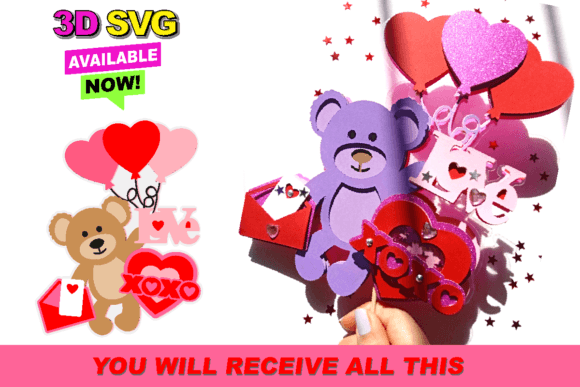
An SVG, or Scalable Vector Graphic, is a vector file format that retains crisp edges and clean geometry at any size. The Teddy Bear Love Cake Topper SVG specifically contains layered paths and shapes depicting a teddy bear motif with heart accents, designed for use as a cake topper. Unlike raster images, this file allows you to resize the bear from a tiny cupcake pick to a large centerpiece without losing quality. The file typically separates elements into distinct layers—bear body, ears, heart, and any decorative text or banners—which gives you control over color, material, and placement during production.
For anyone who produces physical goods, this separation is the difference between a generic topper and a custom piece that matches a client's color palette or theme. If you are cutting this on a Cricut, Silhouette, or laser cutter, the layered SVG structure reduces manual tracing time and lowers the chance of misaligned cuts.
Where This Asset Fits in Your Workflow
The Teddy Bear Love Cake Topper SVG is not a final product in itself; it is a raw material that moves through your production pipeline. Its role shifts depending on where you are in the process.
Before the Project: Planning and Asset Selection
During the planning phase, you evaluate the SVG against project requirements. If you are a baker or cake decorator, you may need to confirm the topper fits the cake dimensions, the message aligns with the occasion (baby shower, birthday, Valentine's Day), and the complexity matches your cutting equipment. For a graphic designer or blogger creating digital mockups, you assess whether the bear style complements the overall aesthetic of your brand or template.
At this stage, open the SVG in a vector editor like Inkscape, Adobe Illustrator, or Canva Pro to inspect the layers. Check for:
- Layer naming – clear names make it easier to recolour or isolate parts
- Path complexity – too many nodes can cause cutting errors on slower machines
- Closed paths – essential for software that fills or cuts along outlines
- Proportions – the bear should scale evenly without distorting the heart or face
This pre-processing step takes ten minutes but saves you from wasted material or rework later. If you plan to use the SVG for a physical cake topper, also decide whether you need a single-layer flat cut or a multi-layer stacked design. The Teddy Bear Love design often works best as a two- or three-layer piece with the heart on top and the bear silhouette beneath.
During the Project: Production and Customization
Once you have confirmed the file is ready, the SVG moves into active use. This is where the real value of a vector file becomes apparent. You can resize the teddy bear without recalculating dimensions, change its colour to match icing tones or paper stocks, and duplicate elements to create a set of matching toppers for cupcakes.
For creators using a cutting machine, import the SVG directly into the design software (Cricut Design Space, Silhouette Studio, LightBurn). Because the Teddy Bear Love Cake Topper SVG already contains the necessary cut lines, you can skip the manual trace step. From here:
- Adjust the size to fit your cake diameter or cupcake height
- Separate the layers onto different mats if using multiple colours
- Assign material settings (cardstock, adhesive foil, acrylic, wood veneer)
- Add a skewer slot or fold line if integrating with a dowel or stick
If you work in digital marketing or social media content, you might instead use the SVG as a design element in a branded graphic. Import it into a design tool, apply your brand colours, and export as a PNG with transparency. The vector format ensures the edges remain sharp even when used across different display sizes—from Instagram stories to website banners.
One practical tip: when using the SVG in a software that does not natively support vector files (like Canva's free tier), convert it first to a transparent PNG at the resolution you need. This preserves the clean lines while keeping the file compatible with your platform.
After the Project: Storage, Reuse, and Organization
Completion of one project does not mean the SVG is finished. The Teddy Bear Love Cake Topper SVG can be reused for future orders, themed content, or as a base for derivative designs. The key to long-term efficiency is how you store and tag the file.
Create a folder structure on your computer or cloud storage that groups SVGs by theme (e.g., "Animals", "Love Themes", "Cake Toppers") and includes a metadata tag for the occasion. If you run a small business, add a note about which material settings worked best for that design. For example, "TeddyBearLove_Cricut_Cardstock_80lb" helps you replicate a successful cut without testing again.
File naming is another small but meaningful workflow step. Instead of "teddy-bear-cake-topper.svg", use something like "2025_TeddyLove_Topper_MultiLayer_BABYSHOWER_v2.svg". This embeds context directly in the filename, making it searchable and reducing time spent opening files to check their contents.
If you sell digital products or physical goods, this SVG can also serve as a template for custom orders. A client may want the same bear but with different colours or a custom name. Because the original SVG is editable, you can tweak the file quickly rather than rebuilding it from scratch. This scalability is what turns a single design into a revenue stream.
How This SVG Interacts with Other Tools, Materials, and Decisions
No SVG works in isolation. Its effectiveness depends on how well it integrates with your other resources.
Software and Platform Compatibility
Most modern design applications handle SVGs well, but not all treat them identically. If you use Adobe Illustrator, the file retains its original layer structure and can be edited freely. In Cricut Design Space, the SVG imports as a single cut image unless you have separated the layers during export. Silhouette Studio often preserves layers but requires you to release compound paths if the design came grouped. Test your import workflow once with the Teddy Bear Love file to see how your specific software behaves, then document that process. This eliminates guesswork during time-sensitive orders.
For laser cutters and engravers, ensure the SVG paths are set to a stroke and no fill for the cut layer. Many vector files use fill colours that confuse laser software. A quick pass with "object to path" functions prevents misfires.
Material Selection and Quality Control
The success of a physical cake topper also depends on material properties. If you cut the bear from lightweight cardstock, it may not stand upright on a dense cake. If you use acrylic or wood, check that the SVG's internal cutouts (like the space inside the heart) are large enough for your bit or blade to navigate. A 0.5mm gap may be too tight for a 1.5mm end mill. Adjust the SVG by scaling up the entire design or widening the internal paths before cutting.
Quality control also extends to adhesion. If you are layering multiple pieces, plan the stacking so that the top layer covers the glue points of the layer below. The Teddy Bear Love design works well when the heart sits over the bear's chest and the ears sit slightly behind the head outline. Test the layering sequence in your design software before committing to cut.
Practical Implementation Tips for Smooth Integration
Over time, small adjustments to how you handle this SVG can save significant effort. Consider these observations from frequent use:
- Create a master template file – Place the Teddy Bear Love SVG into a blank document with your standard bleed, safety margin, and material sizes. Leave this template open as a starting point for any project using this design.
- Build a colour swatch library – If you use the topper across different clients or occasions, save a set of colour variations (pink, blue, neutral, gold) as separate SVG files or as styles in your design tool. This reduces repetitive colour picking.
- Record your cut settings – Write down the blade depth, pressure, and speed that worked for this SVG on your machine. A simple note in a text file or spreadsheet saves material and time on repeat jobs.
- Test scale first – Cut a small test in cheap paper before using premium material. Check that the bear's proportions still read well at the target size. At very small scales (cupcake toppers under 5cm), some detail like the heart outline may become too delicate to cut cleanly.
- Use the SVG as a teaching tool – If you run workshops or create tutorial content, the Teddy Bear Love design is approachable for beginners learning vector editing. Its clear shapes help learners practice scaling, rotating, and layering without frustration.
Long-Term Use and Scalability
The Teddy Bear Love Cake Topper SVG is not a disposable asset. If you treat it as a reusable component within a larger system, its value compounds over time. For small business owners, this means offering the same base design in multiple variations without starting from zero each time. For hobbyists, it means creating a cohesive set of holiday or event toppers that share a consistent style.
Over months of use, you will likely develop a personal workflow: download, inspect, resize, assign material, cut, assemble, package. Each repetition makes the next one faster. The key is not to skip the early steps of inspection and testing just because the file looks ready. Vector files from third-party sources sometimes contain hidden artefacts, overlapping paths, or incorrect scaling that only appear during production. A brief quality check before integrating the SVG into your project ensures that your output matches your expectation.
For professionals who manage multiple clients or product lines, consider maintaining a version log for each SVG. Track when you modified the file, what you changed, and which client or product used that version. This level of organization supports consistency across repeat orders and helps you avoid sending the wrong variation to the wrong customer.
Ultimately, the Teddy Bear Love Cake Topper SVG earns its place in your workflow not because of a single project, but because of how it performs over the lifecycle of many projects. It is a small but reliable component that, when handled with intentional planning and clear process, produces consistent, professional results every time.